Monday, July 18, 2016

Future of Nursing Report Calls for Nurses to Join Healthcare Boards

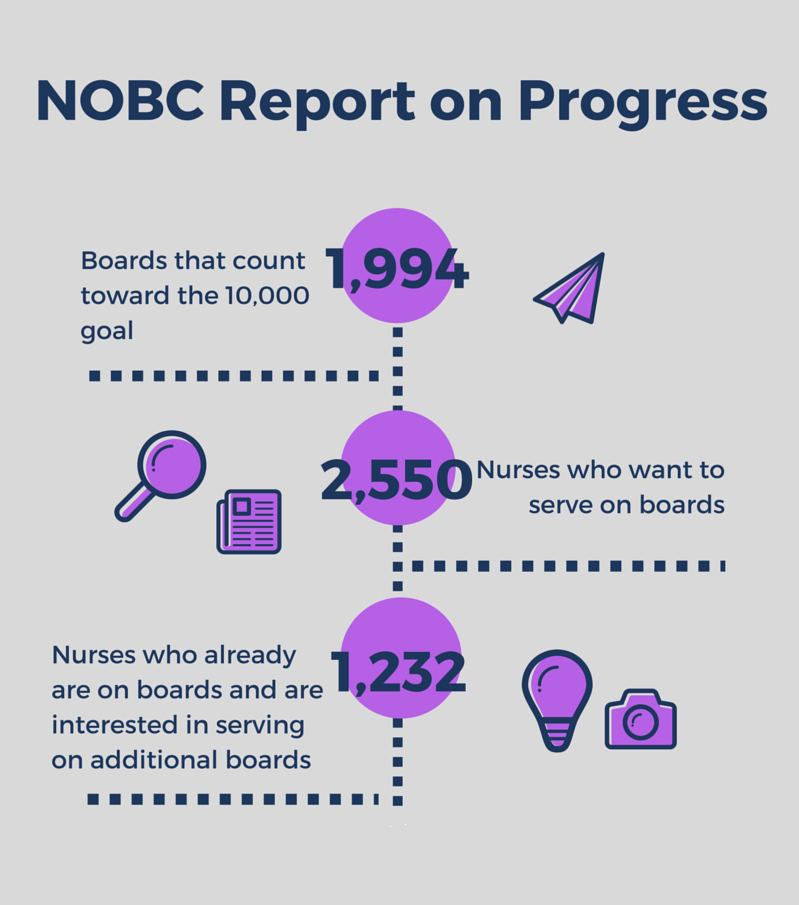
Do you or any of your colleagues serve on a board? One of the key messages in the Institute of Medicine (IOM) Future of Nursing report is, "Nurses should be full partners with physicians and other health professionals in redesigning healthcare in the U.S." Being a full partner translates to the health policy arena, where the report suggests, "Nurses should also actively serve on advisory committees, as commissioners and on boards where policy decisions are made to advance health systems to improve patient care." Nurses need to exercise leadership competencies in a collaborative environment in all settings, including hospitals, communities, schools, boards, and policy and business arenas both within nursing and across the health professions. The Nurses on Board Coalition (NOBC), created by the collaborative efforts of 21 nursing organizations, has a goal of placing 10,000 nurses on governing boards by 2020.

Let your voice be heard! If you are serving on a board now or would like to serve, go to www.nursesonboardscoalition.org and register by clicking on the "Be Counted" link at the top of the page.


References
Institute of Medicine. (2010). The future of nursing: Leading change, advancing health. Washington, D.C.: The National Academies Press.


Nurses on Boards Coalition. (2016, May 10). Re: NOBC Nurse Leader Letter. Retrieved from: https://mail.goggle.com/mail/u/0/?ui=2&ik=8f28728c50&view=pt&search=inbox&th=1549c290 71fd8b08&siml=1549c29071fd8b0&siml=154a65c5e5050950&siml 

Tuesday, July 5, 2016

How to Edit Your Abstract: 3 Essential Tips

Allie Mandel is the Education Associate for ANPD and graduated from OSU with a degree in English.

The opportunity to present an abstract allows nurses to showcase their projects and portray how the strides they have made can improve the role of the NPD nurse. The ability to write an abstract is an important skill for NPD practitioners to possess, but the aptitude to edit your own abstracts will elevate your writing to the next level so that your research truly stands out. While editing your own work may seem daunting, these tips will help you to present a clear, concise, and, consequently, more effective report.

Take Some Space
You’ve worked long and hard to produce an abstract that showcases the effectiveness of your report, and editing that abstract after all the effort you have put in probably sounds less than ideal. Before you dive in to the editing process, take a break to distance yourself from your abstract—go for a walk, read a book, eat a snack, do whatever you need to do to refresh your mind before undertaking the next step in the abstract submission process. If editing your abstract still seems overwhelming, break your writing down into chunks and tackle it piece by piece.

Keep it Simple
An effective abstract summarizes the report without unnecessary elaboration or “fluff,” so it is important to stick to the facts and keep your abstract brief. If your abstract is peppered with long sentences containing several ideas, break those sentences down into 2-3 succinct ones—shorter sentences add an element of conciseness, allowing each sentence to pack a greater punch. When in doubt, remember that less is always more; rather than adding to your abstract, trim down the paragraphs that include excess or redundant information. Additionally, steer clear of big, fancy words—keep the language as simple as possible so that anyone who reads your abstract understands the main takeaways.

Use Your Resources
Even the strongest writers and editors find themselves stumped from time to time, and there are plenty of online resources you can utilize to make the editing process seem less intimidating. Whether you need assistance with grammar and punctuation, formatting, or even proofreading strategies, websites like the
Purdue Online Writing Lab (OWL) or Guide to Grammar and Writing are excellent tools to keep in mind. You can also find abstract-specific resources by researching other organizations; for example, the International Association of Clinical Research Nurses’ (IACRN) site includes a PowerPoint presentation, “Writing a Conference Abstract: Tips for Success,” that you may find helpful when editing your abstract. A peer review is another great way to edit your abstract—a second pair of eyes is always helpful!

Monday, June 20, 2016

Presenter Do's and Don'ts

As NPD Practitioners, giving presentations using slides is nothing new. Most of us can whip up a PowerPoint in a few minutes if needed. But have you ever thought about the kind of presentation you want to give and the type of presenter you want to be? Below, find some “do’s and don’ts” for presenters.

Do’s
  • When listening a great presentation, make notes as to what the presenter is doing to keep you interested and engaged.
  • When listening to a not-so-great presentation, make note of what the presenter does that turns you off.
  • Make sure you use powerful images that are relevant to the content, otherwise they only distract and confuse the learner.
  • Connect with your audience – use emotion in your voice, personal stories, and examples to get your point across.
  • Provide takeaways during your presentation that the audience can implement.
  • Limit your number of slides and make every word and image count.
  • Practice, practice, practice! A well-prepared and polished presentation is effective (and noticeable).  

Don’ts
  • Your slides should not be filled with words – this is boring and learners tend to tune out.
  • Don’t use a monotone voice when speaking and make sure you’re not just reading your slides or directly from your notes. This doesn’t allow you to connect with your audience.
  • Don’t try to be funny if you’re not. Instead of trying to “dress up” your presentation with humor, simply focus on delivering an engaging message.
  • Avoid color combinations on slides that are difficult to read.
  • Don’t wing it – you’ll be doing a disservice to your audience and wasting their time. They are there to learn.
  • Don’t forget to prepare for questions – try to anticipate the kinds of questions that might be asked and have an answer ready.

Monday, June 6, 2016

Developing Leadership Skills

Barbara Brunt, MA, MN, RN-BC, NE-BC is an Education Consultant and past ANPD President.


 Leadership is not a title - anyone can be a leader.  All NPD specialists, regardless of our role, can continue to develop leadership skills.  I have used the letters of the word leadership to outline some of the characteristics of a leader.

          Learning is critical to leadership – learning and competence matter.  We need to be lifelong learners and constantly seek out new knowledge.  We learn by making mistakes – they help us grow and are NOT failures.  Thomas Edison said “I have not failed, I just found 10,000 ways that will not work”, and “our greatest weakness lies in giving up. The most certain way to succeed is always to try just one more time.”  There are multiple resources for your professional development, such as webinars, books, online courses, etc, available through ANPD.

          Empowering others is important.   Webster defines empowerment as “giving power or authority to or give ability to”.  We need to help our coworkers and others feel significant, showing concern and caring.  Pierre de Chardin said, “The most empowering relationships are those in which each partner lifts the other to a higher possession of their own being.”  We need to lift others up to fully develop our own leadership skills.

          Accountability and aspiring for excellence are other characteristics of leadership.  Leaders take accountability for their decisions, and constantly aspire to be the best they can be.  We need to continually strive for excellence, even though we realize we may not get there.

          Driving innovation is another component of leadership.  Webster defines innovation as introducing new methods or devices.  All of us need to question why – because we have always done it that way is not an acceptable answer.  There is an increasing amount of literature providing the best evidence for our care – leaders need to constantly look for better ways of doing things.  Consider applying for a research grant, if you want to validate an innovative approach to teaching or NPD practice.

          Embracing change is a critical skill in today’s ever-changing health care environment.  Change is a constant, and we need to accept that fact.   John F. Kennedy said, “Change is the law of life.  And those who only look to the past or present are sure to miss the future.”  Not only do we need to accept change, but we need to serve as change agents to help others cope with change.  A few of my favorite quotes about change are:
Gandi – Be the change you wish to see in the world
Socrates – The secret of change is to focus all of your energy not into fighting the old but on building the new
Norm Brodsky (Entrepreneur) – Either you are an agent of change or you are destined to become a victim of change.  You simply can’t survive over the long haul by standing still. 
I think these quotes emphasize the importance of your reaction to change.

          Resolving conflicts is essential to success when applying leadership skills.  Conflict is inevitable and we need to deal with it rather than letting it fester.  Resolving conflicts is often not pleasant and we tend to procrastinate when there is something we don’t want to do; however, that will not make the conflicts go away.  The first step to conflict resolution is to recognize what factors contribute to conflict.  Some of these are:  differences in values, fear, miscommunication, treatment of others, honesty, and attitudes.  Four basic strategies for resolving conflicts are accommodation, assertion, avoidance, and negotiation. 

          Serving others and seeking out a mentor are two other leadership characteristics.  Servant leadership can be helpful in getting others to work towards a common goal.  Servant leadership is both a leadership philosophy and set of leadership practices. Traditional leadership generally involves the accumulation and exercise of power by one at the “top of the pyramid.” By comparison, the servant-leader shares power, puts the needs of others first, and helps people develop and perform as highly as possible.  People love to follow servant leaders

          A mentor can open doors and present opportunities for your personal and professional growth.  A mentor is different from a preceptor.  Mentors do not have to work in the same facility or even be in the same state.  Belinda Puetz is one of my mentors.  When I was actively involved in the National Nursing Staff Development Organization, she was the Executive Director of that group.  The American University of Beirut in Lebanon was looking for a staff development consultant to do an on-site visit, and she suggested they contact me.  I went there back in 1999 and helped them further develop their staff development program.  Gladys Mouro, who was the CNO at that time, became a board member of STTI later.  I believe her letter of support helped me receive one of the STTI Founders awards, because of the emphasis on global impact.

          Honing collaboration and teamwork skills are critical skills for leaders.  With the focus on interprofessional education and teamwork, we need to work closely with other members of the healthcare team.  With the complexity of health care today, it takes a village with multiple skill sets to most effectively care for our patients. Research has long suggested that interprofessional collaboration improves coordination, communication and, ultimately, the quality and safety of patient care. It utilizes both the individual and collective skills and experience of team members, allowing them to function more effectively and deliver a higher level of services than each would working alone.

          Inspiring others and getting involved is important.  Providing a clear vision can motivate others to become more involved.  Great leaders inspire others.  John Quincy Adams said, “If your actions inspire others to dream more, learn more, do more, and become more, you are a leader.”  ANPD has a lot of opportunities for you to get involved in whatever activities resonate with you.  You can become involved by being a part of a committee, or volunteering for a task force or specific task, such as reviewing chapters in ANPD publications.

          Providing feedback is the last leadership characteristic.  The important of clear and frequent communication, both written and verbal, can’t be overemphasized.  You need to let your coworkers know what they are doing well, or if there are things they could be doing better.  My background as an English teacher has served me well throughout my career – I love to write, and my initial education provided me with the tools to communicate clearly both verbally and in writing. 

          You never know what difference you will make in someone’s life. I challenge all of you to develop your leadership skills and make a difference.  
Wednesday, May 25, 2016

Social Media & Learning

Can social media be used to promote learning? Learn more: http://bit.ly/1svvDUv. Share your ideas, experiences, and/or outcomes related to the use of social media in your NPD practice.
  • Tweet your ideas to ‪#‎ANPDSHARE.
  • Like the ANPD Facebook page and share your experiences.
  • Search LinkedIn for Association for Nursing Professional Development and ask to join the group in order to begin sharing your ideas.
  • Start a pinterest board on educational resources for topic of interest and share the link on any of the above sites
  • Share your suggestions in the comment section below

Monday, May 23, 2016

6 Megatrends in Future of Healthcare

The World Congress on Continuing Professional Development, held March 17-19, welcomed some of the top influencers in CPD, including ANPD’s very own President Joan Warren and Education Director Mary Harper. This event featured cutting-edge topics held for CME/CPD and IPE professionals from around the globe to “Advance Learning and Care in the Health Professions.” 

While there, Mary and Joan attended a session by Ezekiel J. Emanuel, author of the book “Reinventing American Health Care.” During this presentation, he projected six “megatrends” to look for in the future of healthcare:
  1. The diffusion of VIP care for the chronically and mentally ill.
  2. The emergence of digital medicine and closure of hospitals (fewer hospitalized patients and more care-at-home and non-hospital environments).
  3. The end of insurance companies as we know them.
  4. The end of employer-sponsored health insurance.
  5. The end of healthcare inflation.
  6. The evolution of Academic Health Centers.
Mary points out that he also forecasted learning on the go with learner drive timelines and learner-driven platforms will be trending in the future. 

Monday, May 9, 2016

Happy Nurses Week!


Happy Nurses Week! We want to recognize the energy and commitment you give every day to being a nurse, whether you’re on the floor or in a leadership role. We applaud you!

National Nurses Week begins each year on May 6th and ends on May 12th, Florence Nightingale’s birthday. The first “National Nurse Week” was observed from October 11-16, 1954. That year marked the 100th anniversary of Florence Nightingale’s mission to Crimea.  That was the only year Nurse Week was observed until the ANA expanded the recognition of nurses from one day to an entire week in 1990 and the May 6 – 12 dates have been the national standard since 1994.

National Nurses Week is a time to celebrate and recognize nurses who work in every field in healthcare, but it is also a time to reflect on how far nursing has come. And to do that we need to look at the woman who started it all – Florence Nightingale. Many of you most likely know her story: born in 1820 in Florence, Tuscany, came to prominence during the Crimean War, and laid the foundation for professional nursing by establishing a nursing school in London. In 1912, the International Committee of the Red Cross instituted the Florence Nightingale Medal, which is awarded every two years to nurses or nursing aides for outstanding service. We’ve been celebrating International Nurses Day on her birthday since 1965. And statues of Florence can be seen around England.

But did you know that her parents didn’t want her to enter the nursing field? They were an affluent family who ran with elite social circles and expected Florence to get married and start a family. Florence, however, had a different idea. She started caring for the ill and poor in her village at an early age and by the time she was 16, decided that nursing was her calling. Her nickname “The Lady with the Lamp” was earned during the Crimean War when she would make rounds well past dark, armed only with a lamp, providing comfort to injured soldiers. Besides being a gifted nurse, Nightingale possessed strong math skills. She became a pioneer in the visual presentation of information and statistical graphs and is credited with developing the polar area diagram to illustrate seasonal sources of patient mortality.

As we reflect on the history of nursing, we also look forward to the future and know that with the strong, compassionate, and driven nurses we have in the field today, that future will be bright. Thank you all, and again, happy Nurses Week!


*If you are interested in learning WWFD – or What Would Florence Do – check out the new book by ANPD member Sue Johnson, PhD, RN-BC, NE-BC, What Would Florence Do? A Guide for New Nurse Managers available here.