Wednesday, May 25, 2016

Social Media & Learning

Can social media be used to promote learning? Learn more: http://bit.ly/1svvDUv. Share your ideas, experiences, and/or outcomes related to the use of social media in your NPD practice.
  • Tweet your ideas to ‪#ANPDSHARE.
  • Like the ANPD Facebook page and share your experiences.
  • Search LinkedIn for Association for Nursing Professional Development and ask to join the group in order to begin sharing your ideas.
  • Start a pinterest board on educational resources for topic of interest and share the link on any of the above sites
  • Share your suggestions in the comment section below

Monday, May 23, 2016

6 Megatrends in Future of Healthcare

The World Congress on Continuing Professional Development, held March 17-19, welcomed some of the top influencers in CPD, including ANPD’s very own President Joan Warren and Education Director Mary Harper. This event featured cutting-edge topics held for CME/CPD and IPE professionals from around the globe to “Advance Learning and Care in the Health Professions.” 

While there, Mary and Joan attended a session by Ezekiel J. Emanuel, author of the book “Reinventing American Health Care.” During this presentation, he projected six “megatrends” to look for in the future of healthcare:
  1. The diffusion of VIP care for the chronically and mentally ill.
  2. The emergence of digital medicine and closure of hospitals (fewer hospitalized patients and more care-at-home and non-hospital environments).
  3. The end of insurance companies as we know them.
  4. The end of employer-sponsored health insurance.
  5. The end of healthcare inflation.
  6. The evolution of Academic Health Centers.
Mary points out that he also forecasted learning on the go with learner drive timelines and learner-driven platforms will be trending in the future. 

Monday, May 9, 2016

Happy Nurses Week!


Happy Nurses Week! We want to recognize the energy and commitment you give every day to being a nurse, whether you’re on the floor or in a leadership role. We applaud you!

National Nurses Week begins each year on May 6th and ends on May 12th, Florence Nightingale’s birthday. The first “National Nurse Week” was observed from October 11-16, 1954. That year marked the 100th anniversary of Florence Nightingale’s mission to Crimea.  That was the only year Nurse Week was observed until the ANA expanded the recognition of nurses from one day to an entire week in 1990 and the May 6 – 12 dates have been the national standard since 1994.

National Nurses Week is a time to celebrate and recognize nurses who work in every field in healthcare, but it is also a time to reflect on how far nursing has come. And to do that we need to look at the woman who started it all – Florence Nightingale. Many of you most likely know her story: born in 1820 in Florence, Tuscany, came to prominence during the Crimean War, and laid the foundation for professional nursing by establishing a nursing school in London. In 1912, the International Committee of the Red Cross instituted the Florence Nightingale Medal, which is awarded every two years to nurses or nursing aides for outstanding service. We’ve been celebrating International Nurses Day on her birthday since 1965. And statues of Florence can be seen around England.

But did you know that her parents didn’t want her to enter the nursing field? They were an affluent family who ran with elite social circles and expected Florence to get married and start a family. Florence, however, had a different idea. She started caring for the ill and poor in her village at an early age and by the time she was 16, decided that nursing was her calling. Her nickname “The Lady with the Lamp” was earned during the Crimean War when she would make rounds well past dark, armed only with a lamp, providing comfort to injured soldiers. Besides being a gifted nurse, Nightingale possessed strong math skills. She became a pioneer in the visual presentation of information and statistical graphs and is credited with developing the polar area diagram to illustrate seasonal sources of patient mortality.

As we reflect on the history of nursing, we also look forward to the future and know that with the strong, compassionate, and driven nurses we have in the field today, that future will be bright. Thank you all, and again, happy Nurses Week!


*If you are interested in learning WWFD – or What Would Florence Do – check out the new book by ANPD member Sue Johnson, PhD, RN-BC, NE-BC, What Would Florence Do? A Guide for New Nurse Managers available here.

Monday, April 18, 2016

E-learning Tips

In this day and age of on-the-go learning, NPD practitioners are tasked with developing content that goes beyond the traditional format of lecture and slides. This may seem daunting, but e-learning (or learning that occurs via electronic media) opens up a whole new realm of education. Learners can interact with the content in a way that lectures don't provide. The barrier between educator and learner is taken down. 

Below are some tips to remember when creating e-learning, but the first step would be to do some research. E-learning is more than just adding interactivity to some slides, so take some time to educate yourself about creating content and what the best platforms are to build that content within. Some software even has a free trial so you can actually play around with content and see if the platform works for you. You may want something that already has some structure built in so you can just plug in the information or you may choose something that allows you more freedom to create the content as you see fit. Test a few different softwares to see what the is the best fit for you.

One more disclaimer - the tips below are for e-learning, but can be applied to mobile learning (or learning that occurs via mobile devices such as a phone or tablet). However, mobile learning requires some different parameters when creating and launching the content, so make sure you research and understand those before building the course.

  1. The first step is to know your audience. Who are the learners and what are their educational needs? Are they familiar with the topic already or is this something completely new to them? Will your learners be novices or experts? Also, there is a bit of a learning curve for some when it comes to technology, so keep that in mind when building your course.
  2. When deciding what content needs to go into the course, make sure you separate the information that your learners need to know from the information that's nice to know. Ask yourself - Is this information critical? Will the learners need to know this information in order to do their job? If they don't have this information, what would be the impact? Omit content that does not help the learners do their job. For example, when teaching someone how to bake a cake, they don't need to know the history of cake baking in order to successfully bake a cake. 
  3. There is a basic course structure for e-learning (which is similar to most learning structures):
    • Welcome your learners to the course.
    • Include instructions explaining how to navigate the course, what buttons they need to click, etc.
    • Add an introduction telling the learners why they are taking the course and how they will benefit by learning the content.
    • Outline the course objectives or outcome statement.
    • Build your course content. Modules shouldn't be longer than 10 slides (or about 20 minutes). Learners lose attention and concentration after that amount of time. Make sure parts of your content play to different types of learners - auditory as well as visual. 
    • Summarize the course objectives.
    • Offer references and resources that reinforce the material.
    • Give final instructions on how to maintain contact hours and exit the course.
By following these three tips, you'll be on your way to creating engaging e-learning content!

Monday, April 4, 2016

Q&A from the Clinical Placement Tools Webinar

On Thursday, March 24th, Pam Taylor, PhD, RN-BC, CPHIMS, owner of Total Clinical Placement System, presented a webinar entitled "Using Clinical Placement Tools to Streamline Student Onboarding." Below are the answers to questions posed during the webinar.

Q1:  When you discuss the attestation vs. facilities collecting personal data--I'm not sure I understand. We have built in our contracts that personal information such as immunization records are stored at the school but must be made available upon request. For our access to EMR we must have student names, birthday and last 4 of SSN and we also collect emergency contact information from each student--so based on our practices are we a "blended" method for gathering student information? I'm assuming attestation decreases our risk, but we certainly need some of the information or students will not gain access to our EMR.

A1:  Access to student data can certainly be outlined by the school affiliation contracts.  The key is to make sure that when you do collect the data that it is treated as personal information and stored/discarded appropriately.  The personal data needed for EMR access is really no different that is collected on an employee. 

Q2: Does FERRPA apply to high school students’ clinical placements?

A2:  Yes, FERPA covers all ages of students.

Q3: Does the clinical placement tool support scheduling multiple sites?

A3:  Clinical Placement tools should support multiple sites.  This is a question to ask the vendor in the selection process.  TCPS PlacementPro does support multiple sites.

Q4: Are you able to schedule in and out patient environments?

A4:  Clinical Placement tools should support the in- and out-patient environments.  This is a question to ask the vendor in the selection process.  TCPS PlacementPro supports any healthcare environment.


Q5: Will you elaborate on what components of pre-implementation data to collect?

A5:  Pre-implementation data that can be useful to collect prior to implementation for data supported ROI calculations include:
  • Number of clinical placements (Be sure and use a standardized definition of a clinical placement!  I traditionally use a single shift, single day, and single unit during an academic term or portion thereof for a single school as the definition.)
  • Time spent approving/denying clinical placements by all involved employees
  • Time spent creating reports related to clinical placements.
  • Time spent on development, preparation and delivery of Student orientation by all involved employees
  • Time spent on development, preparation and delivery of Faculty orientation by all involved employees 

Additional data needs could be identified based upon your target goals for implementing student onboarding tools.


Q6: Will you cover cost?  Do organizations tend to pass this cost onto the school or students?  What has been the response from schools?  Does this impact the # of schools requesting placement?

A6:  I’ve seen the cost of related to clinical onboarding tools absorbed by the facility as a community engagement/marketing/employment pipeline support line item.  I’ve also seen it passed back to the school either as a specific charge for providing clinical opportunities, or by requiring them to join a collaborative to share the cost.   How the implementation of the onboarding tools is approached (as a process to streamline placement requests and subsequent orientation requirements) with the schools can go a long way in their acceptance of the fees related to the use of technology. 

Q7: What about the CMS Inpatient Quality requirement that student's flu vaccines are required to be submitted to the facility for reporting? Would this be PHI covered by FERPA?

A7:  CMS does not require any specific student data – only the number of students (trainees) in the facility between October 1 and March 31 that had a flu vaccine, the number that had a medical waiver, and the number who declined.    Healthcare organizations collecting more information about the immunization (date, provider, lot number, etc.) pushes the data in over into the “employee record” category that must be protected under Federal guidelines for storage and disposal.

Q8: Can requests from schools be staggered based on priority schools?  Such as BSN schools scheduling,

A8: Clinical Onboarding tools should not set policy.  It is up to the facility to respond to placement requests based upon their own goals and policies.  In TCPS PlacementPro, DEUs may be identified, specific patient care areas may be designated for BSN only, etc.

Q9: Can you clarify what data needs to be collected for standard regulatory bodies?

A9:  Students in the healthcare environment present a challenge in data management since they are technically NOT employees, but are in the healthcare organization and often providing hands on patient care.  Regulatory agencies only mandate that student screening qualifications match what is done for employees.  This does not mandate data collection that is held by the healthcare organization.  Proof that the screening was done and that the data met organization criteria is sufficient for regulatory surveys.  Affiliation agreements should mandate what screenings and pre-requisites are needed that can include criminal background checks, urine drug screens, immunization records/waivers, and current CPR training.  Remember that if your affiliation agreement requires certain data to be on file with the school, then an attestation statement from the school that all data requirements are met on each student is sufficient.  If this data is transferred to the healthcare organization, remember that it must be treated as employee data, and protected/discarded appropriately since it contains sensitive information.  Student Onboarding tools can store the attestation data which is a huge time saver for the school.  Having access online to this data when The Joint Commission or State visits provides immediate access rather than waiting for the school to respond with to an audit request related to the visit.

Q10: Can you give an example of a collaborative arrangement?

A10: Collaboratives are generally formed between a group of facilities and schools (or it could one facility and the schools that send students to the facility) that come together to use a common set of clinical onboarding tools and work together to standardize related processes. I have worked with both types of collaboratives to implement onboarding tools.

Q11:  How can you implement an onboarding system like this for students when you are also required to provide staff education programs and new hire orientation?

Q11:  One of the goals for implementing clinical onboarding tools is to streamline this work so you can meet those other responsibilities.   While you may need to phase in the various tools based upon your own needs, the outcome should be decreased time spent once the system is in place.

Q12:  Does the scheduling tool keep requests private from the other school requests?


A12: Our placement scheduling tool readily shows if another request is in the system for a given placement to alert additional schools requesting the same placement that a decision between schools will have to be made if they submit the placement request.  This feature often saves time for the school and minimizes multiple requests for the same learning opportunity.  

Monday, March 21, 2016

Insights from a Bedside Nurse

Hazel Torres, MN, RN is Assistant Director for SPCMG Regional Professional Development and Research in Pasadena, CA.


I am married to a bedside nurse and he is the biggest critic of the work of NPD Specialists.  From his world view, the “educators” (his term) walk around the units with clip boards (he must have had several of these in his career as a nurse), critiquing what the staff are doing, coming up with new acronyms and talking about concepts that reside in the theoretical, ideal and even magical world (did I mention that he’s the biggest critic?).

I actually think that there are more nurses out there who think like him than we care to acknowledge.  He is more open and frank about his opinions with me because he is also the biggest supporter for my success in my role as an NPD specialist. He’s always more than happy to share with me how HE thinks I could be successful in what I do.  I’m sharing these insights in case you need a source for candid, not-quite-so-nice feedback that’s deeply rooted in love and the desire for improvement. Here are some of the things that he’s shared with me over time:
  1. Be credible.  If you have not walked a shift in the nurses’ clogs, it would be very difficult for you to engage them for any education you have to do.   As an NPD specialist, you would be hard pressed to deliver your message or your education across if you can’t relate to the woes of a bedside nurse.  It would be important for you to understand good vs. bad times during the shift, bedside lingo vs. theoretical terms, etc.  He is more likely to be engaged with someone who he knows to have gotten “their hands dirty” at one point in their career.  This concept becomes even more critical when you are assigned to a specialty department such as L&D or ED or ambulatory.  He further suggests that being current doesn’t just mean reading the latest professional journals and attending conferences; he thinks that this would be enhanced by the NPD specialist coming to a unit or department to be immersed in physician, patient and staff interactions and learning about its culture and unspoken language.  This immersion also would provide the NPD specialist valuable insight for conducting needs assessment and the opportunity to reinforce previously taught concepts.
  2.  Don’t leave out structure, process and outcomes.  When teaching theoretical concepts or “niceties”, always relay how this is actually supported by the department’s structure, processes, and workflows.  Giving real life examples on how to do it right and how to do it despite having to overcome perceived barriers or frustrations give the nurses the ability to translate it into their practice a lot quicker.  He admits that despite the desire to have evidence-based practice, there has to be a conscious effort from the NPD specialist to go against practice-based practice.  Educating the nurses on the structures, processes and workflows associated with the concept being taught lessens this burden for the nurses.  It’s also important to address some questions in their heads – “How will this be measured?”  “How will it be sustained?” “What’s in it for me?” According to him, one of the first thoughts that cross a staff nurse’s mind during an in-service is that this is yet another “flavor of the month”.  There should be an emphasis on what initiative this is replacing or enhancing (if any) and how this will be sustained in what time frame.  An NPD specialist who goes to teach a new concept without knowledge of its application will not only be ineffective and wasting everyone’s time, they will also lose credibility with their audience.
  3. Listen.  Some of the staff could have ideas on how improvements could be made in their department.  Some of these ideas are not necessarily related to clinical education, however, the staff might look to the NPD specialist as a resource or an advocate for their concerns.  They might have suggestions on how the trays could be delivered to the patients’ rooms while you’re giving a class on improving HCAHP scores.  Discuss the suggestion after the class but don’t dismiss it.  Even after you bring this up to the appropriate person or committee, you might not be able to influence the workflow of the dietary department but you would have gained the staff’s trust and respect for advocating for their cause and moving their ideas forward.
  4. Be an advocate.  As nurses, we have a very keen sense of reading into other people’s intentions.  The staff nurses often respond to the intentions that they perceive the NPD specialist has in delivering the education.  In other words, your primary goal as a NPD specialist is not to teach, it is to affect change; the idea is not to tell people how it should be done but rather to influence their thinking to want to do the right thing.  Use reward and recognition as often as you would coaching and counseling.  Be an advocate for the staff nurses and the nursing profession itself as much as they, the staff nurses, are advocates for their patients.
  5. Practice what you preach.  Nobody wants to hear “do as I say not as I do” especially as adults.  He says that he learns from the NPD specialists not just by attending their classes but more so by observing how they conduct themselves outside of the classroom.  Remember his observation about walking around with a clipboard?  That might not have been a detail his previous NPD specialists paid attention to but he definitely did.  He says that it’s important for the NPD specialist to acknowledge that they’re always being observed.  It’s important to give the staff something more meaningful to learn from such as communication skills, leadership styles and even de-escalation techniques; the staff might still notice what you’re wearing or carrying but this way, they actually learn from what you’re doing.
At the end of the day, he acknowledges that professional development is a calling requiring different skill sets than what we have learned in nursing school and in practice.  He ends with this witty remark – “If you’re teaching 5 year olds, you don’t have to act like a five year old. You just have to understand what motivates them and know how to communicate with them”.  . To become successful nurses, we learn the skill of constantly assessing and evaluating the needs of the patients we serve.  To become successful NPD Specialists, we must also learn the skill of constantly assessing and evaluating the needs of the nurses that we serve.  After all, we have to effect change in the nurses’ skills, knowledge and behavior in order to meet our ultimate nursing calling of improving the health and welfare of the communities we serve.  What feedback have you received (good, bad, or ugly) that has changed the way you perform your responsibilities as NPD specialists?

Monday, March 7, 2016

The Journey Toward LGBT Cultural Proficiency

Tim Rodden, MDiv, MA, BCC, FACHE, is the Director of Pastoral Services at Christiana Care Health Systems and is Co-chair of the United Way of Delaware PRIDE Council LGBTQ Health Equity Task Force.

There is growing attention to providing culturally competent health care to our patients/families who are lesbian, gay, bisexual or transgender (LGBT). This raises a few questions: Why is this needed? What does LGBT culturally competent health care mean? How do we go about achieving this? I hope to offer some insight into these basic questions in this blog and to whet your appetite to learn more in a Train-the-Trainer webinar that will occur in June 2016.

Let’s begin with a working definition of cultural competence. There are several definitions that have been offered over the years. One of the seminal works in the field of “cultural competence” dates to 1989 when Terry L. Cross, et al wrote Towards a Culturally Competent System of Care: A Monograph on Effective Services for Minority Children Who Are Severely Emotionally Disturbed [Cross, Bazron, Dennis, and Isaacs (1989)].  In it they describe cultural competence as a “set of congruent behaviors, attitudes, and policies that come together in a system, agency, or amongst professionals to work effectively in cross-cultural situations.” In practice, “a culturally competent system of care acknowledges and incorporates, at all levels, the importance of culture, the assessment of cross-cultural relations, vigilance towards the dynamics that result  from cultural differences, the expansion of cultural knowledge, and the adaptation of services to meet culturally unique needs”.

Why should we address LGBT cultural competence in health care? It has been difficult to get a completely accurate picture of the health disparities facing the LGBT communities because we don’t regularly collect sexual orientation and gender identity data like we do for other demographic groupings e.g., race, ethnicity and language. There have been a few relevant studies conducted that help us understand the need for addressing this today in the health care arena. In the 2007 California Health Interview Survey we see the disparities between LGB populations and the heterosexual population in seeking preventive care and in divergent use of emergency services:

% adults delaying/not seeking health care
           - Heterosexual – 17%
           - LGB – 29%

% adults receiving emergency health care
           - Heterosexual – 18%
           - LGB – 24%

In the study When Healthcare Isn’t Caring (2010, Lambda Legal’s Survey on Discrimination Against LGBT People and People Living with HIV) we get a picture of the “perception of care” from the perspective of these groups. 7.7% of LGB and 26.7% of Transgender respondents report they were refused medical care because of sexual orientation or gender identity. Given this it is not unsurprising to see that some LGBT people have the perception that they will be refused future health care for the same reason: nearly 10% of LGB and 52% of Transgender respondents believe they will be refused health care.

Our work is to reduce health disparities and to encourage people to get the health care needed in spite of cultural differences whether sexual orientation, gender identity, or any other cultural factor.

What does LGBT culturally competent health care mean? One of the leaders in advocacy for LGBT people in receiving equality in health care is the Human Rights Campaign Foundation which publishes the Healthcare Equality Index (HEI) each year. The HEI provides a road map for healthcare systems in measuring best practices for LGBT patient – and- family centered care and for LGBT workforce inclusion. 

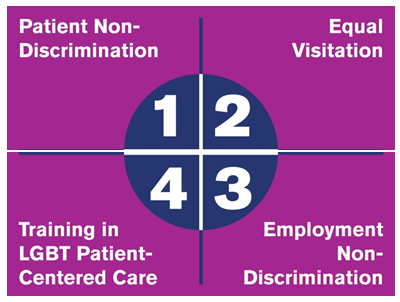
The Core Four Requirements of the HEI address the following four broad policy and procedure areas for health care facilities:


In addition the self-reported survey assesses best practices and gives concrete examples for practices in the following areas:
  • LGBT Patient Services & Support
  • Transgender Patient Services & Support
  • Patient Self Identification
  • Medical Decision Making
  • Employee Benefits and Policies
  • Community Engagement

LGBT patients and families are looking to this published index more and more to seek out health care facilities and by extension their providers who can provide LGBT culturally competent care. Facilities that rank the highest receive the designation of Leader in LGBT Healthcare Equality which sets them apart from other facilities/providers.

How do we go about achieving LGBT cultural competence? Better yet the question might be asked, how do we go about striving for LGBT Cultural Proficiency? Cross, et al describes cultural proficiency: when cultural differences are highly regarded and the need for research on cultural differences and the development of new approaches to enhance culturally competent practices are recognized. This level of achievement goes beyond cultural competence:  when cultural differences are accepted and respected; continuous expansion of cultural knowledge and resources and continuous adaptation of services occur; continuous self-assessment about culture and vigilance toward the dynamics of cultural differences exist.

Achieving cultural competence and perhaps cultural proficiency is a developmental process. First you have to recognize the need for doing things differently, that you may not have all the answers. Secondly, you need to determine who the key stakeholders are in making needed changes to policies and procedures. Thirdly, you need the buy-in and active engagement of leadership so that there is impetus behind the transformation. Lastly I would say you need to actively involve the LGBT community in assessing current state, what needs to change, what can change and to provide the motivation for making the changes. 


Delaware’s largest private employer, Christiana Care Health System, has been participating in the Healthcare Equality Index since 2011 and since 2012 the system’s two hospitals: Christiana Care Wilmington Hospital and Christiana Care Christiana Hospital have received the designation of Leader in LGBT Healthcare Equality. All new nurses hired by the system receive comprehensive orientation. During the orientation day titled “Exceptional Experience” they participate in an education module called Your LGBTQ Patient: Providing Culturally Competent Care

The strategies employed in this education module with additional resources will be presented in the Train-the-Trainer Webinar that Tim Rodden, MDiv, MA, BCC, FACHE and Bret Herb, LCSW will conduct on June 16, 2016 for the Association for Nursing Professional Development. (Tim coordinates LGBT health for Christiana Care and Brett is a gender therapist and mental health consultant for Christiana Care.)